Explore a structured homeschool curriculum for Playgroup, Nursery, LKG and UKG, with guided activities, worksheets, videos and resources for home education


What Your Child Can Do Today
What Your Child Can Do
Children can follow weekly plans, practise worksheets, revise lessons, build habits, and learn confidently at home.


HomeSchool
Mother is the first Guru, and home is the first school.
A child’s greatest learning often begins at home — through love, values, habits, language, curiosity, confidence, and everyday conversations.
HomeSchool by Study100on100 gives a joyful structure to learning at home through age-wise weekly plans that help parents support school learning. It is not a replacement for school , but a meaningful add-on.
Our vision is simple: no child should be left behind, and every child should study 100% by learning to their full potential.
Playgroup | Before Preschool
Before preschool, a child’s first learning happens at home
through a parent’s voice, simple conversations, playful activities, songs, stories, pictures, movement, and everyday routines.
Playgroup | Before Preschool by Study100on100 gives a joyful structure to this early learning through age-wise weekly plans that help parents strengthen their child’s speaking, listening, recognition, motor skills, habits, curiosity, and confidence.
It is not a replacement for a playgroup or preschool. It is a meaningful add-on that gently prepares children for a happy, confident, and joyful start to preschool.


Nursery | Montessori 1


Nursery | Montessori 1 is the stage where a child begins to explore the world beyond home
learning to speak, listen, share, observe, ask questions, follow routines, and build confidence step by step.
Nursery | Montessori 1 by Study100on100 supports this beautiful stage with age-wise weekly learning plans that help parents continue nursery learning at home through stories, rhymes, pictures, worksheets, activities, games, creativity, habits, and joyful practice.
It is not a replacement for Nursery | Montessori 1. It is a meaningful add-on that helps children revise, practise, express, and grow with confidence — so every child gets the right support to learn happily and reach their full potential.
LKG | Montessori 2
LKG | Montessori 2 is the stage where children begin moving from playful recognition to more structured learning
Letters, sounds, numbers, writing readiness, stories, classroom routines, social skills, and independent habits.
LKG | Montessori 2 by Study100on100 supports this important stage with age-wise weekly learning plans that help parents support classroom learning at home through phonics, tracing, early reading, number practice, worksheets, stories, rhymes, games, creativity, and thinking activities.
It is not a replacement for LKG, Montessori, or school. It is a meaningful add-on that helps children revise, practise, speak, think, and build confidence — so every child can learn happily and grow to their full potential.


UKG | Montessori 3
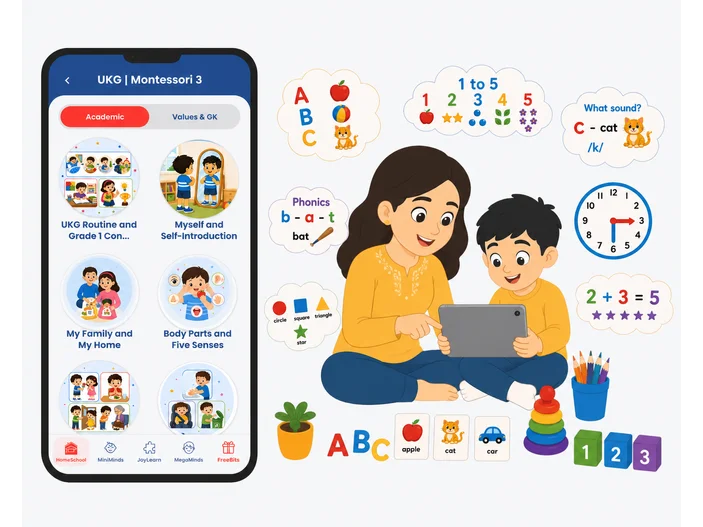
UKG | Montessori 3 is the stage where children begin preparing for Grade 1
Moving from recognition and tracing to early reading, writing, number understanding, simple maths, storytelling, classroom confidence, and independent learning habits.
UKG | Montessori 3 by Study100on100 supports this important transition with age-wise weekly learning plans that help parents support classroom learning at home through phonics, simple reading, handwriting practice, number activities, addition, subtraction, worksheets, stories, rhymes, games, creativity, and thinking activities.
It is not a replacement for UKG, Montessori, or school. It is a meaningful add-on that helps children revise, practise, read, write, count, speak, think, and build confidence — so every child can move towards Grade 1 happily and grow to their full potential.
Your Child's Privacy is Our Priority
We use educational data solely to enhance our services. We never sell or share personal information with any third party. Your trust is valued and protected.
What Parents & Students Say About Us


Study100on100 – Built for today’s students, powered by tomorrow’s technology.
HomeSchool Curriculum and Learning Activities for Kids at Home: Playgroup to UKG | All-in-One Homeschool Learning App
HomeSchool is a parent-guided feature inside the Study100on100 learning app that helps families bring purposeful, age-wise learning into everyday home life. It connects structured Academic learning with good habits, moral values, general knowledge, life skills and school readiness through daily and weekly activities for Playgroup, Nursery, LKG and UKG. For parents comparing a preschool learning app, an educational app for kids or a kids learning app that can support classroom learning, HomeSchool provides a clear starting point. Instead of searching every day for unrelated preschool activities at home, parents can choose the child’s current stage, follow a guided concept and explore relevant images, videos, worksheets, DIY activities, rhymes, stories, learning games and quizzes in one connected experience. Children do not all reach the same milestone at one exact age. The stage names and age-related searches on this page are practical guides, while the child’s present language, motor, social and academic readiness should determine what to explore. HomeSchool can be used before school begins, alongside the school curriculum or for revision and additional practice at home.
A Parent-Guided Preschool Curriculum at Home with Daily and Weekly Learning Activities
Parents often know that home matters to a child’s learning, but they may not know what to teach, how to explain it or how much practice is appropriate. HomeSchool turns that uncertainty into an organised, flexible home-learning programme. Each stage provides guided concepts, learning outcomes, parent prompts and activity support, allowing families to introduce one meaningful idea at a time instead of recreating a formal classroom. The Homeschool programme brings together early language, phonics readiness, pre-writing, reading, numbers, maths, EVS, general knowledge, creativity, social-emotional learning, good manners, hygiene, safety and independent habits. The emphasis changes progressively from first recognition in Playgroup to stronger reading, writing, maths and Grade 1 readiness in UKG. This is not an online preschool, a live tuition class or a replacement for school. It is a structured support system that helps parents continue school learning at home through conversation, practice, stories, games, activities and real-life routines.
HomeSchool Learning Curriculum at a Glance
| What Kids receive | What Kids receive How it helps |
|---|---|
| Playgroup to UKG | Four connected learning pathways that help parents choose the most suitable stage. |
| Academic + Values & GK | Early academics and whole-child development are supported together rather than treated as separate priorities |
| Daily and weekly guidance | Parents receive practical ideas for what to introduce, say, demonstrate, practise and observe |
| Concept360 learning support | A concept can be explored through pictures, videos, worksheets, DIY activities, rhymes, stories, games and quizzes |
| Flexible progression | Activities can be repeated, simplified or extended according to the child’s readiness and current school learning |
| Start free | Families can begin with available free learning content before choosing broader access |
What Should Children Learn at Home Before Grade 1?
Parents search for what to teach a toddler at home, what a Nursery child should learn, how to prepare for LKG or what a child should know before Grade 1. Although the answer changes with the stage, strong early learning usually develops across several connected areas rather than through alphabet and number memorisation alone.
Children need opportunities to listen, speak, observe, move, draw, match, count, compare, ask questions, express feelings and take part in daily routines. Early literacy grows from vocabulary, picture talk, letter recognition and sound awareness into CVC words, sight words and simple sentences. Early maths develops from real-object counting and comparison into patterns, number order, addition and subtraction readiness. School readiness also depends on attention, confidence, self-care, turn-taking, responsibility and the ability to ask an adult for help.
The HomeSchool Learning pathway helps parents connect these skills with age-wise learning activities for kids at home. A theme about food can build vocabulary, sorting, healthy habits and respect for food. A transport concept can connect vehicle names, movement, maths, community awareness and road safety. A story can strengthen listening, sequencing, emotion words and speaking confidence. This connected approach helps children understand ideas in context.
Age-Wise Preschool Learning Activities at Home for Playgroup, Nursery, LKG and UKG
The HomeSchool homepage is the gateway to four detailed learning paths. Choose the stage that best matches the child’s present curriculum and readiness; the age phrases below reflect common parent searches and are not rigid admission rules.
Playgroup | Before Preschool – Activities for Toddlers at Home and First Learning Experiences
For children beginning their learning journey, the Playgroup pathway combines first vocabulary, object and action recognition, colours, shapes, early numbers, crayon control, rhymes, movement, good habits and simple routines. It supports parents searching for activities for toddlers at home, learning activities for toddlers, activities for 2 year olds at home or activities for 3 year olds at home.
Nursery | Montessori 1 – The Homeschooling Program for Kindergarten
The Nursery pathway introduces a more organised preschool curriculum through language, self-introduction, pre-writing strokes, alphabet familiarity, colours, shapes, numbers 1–5, sorting, picture talk, classroom routines, hygiene and social confidence. It is relevant to Nursery learning activities, educational activities for preschoolers and learning activities for 3 year olds or 4 year olds, depending on the school structure.
LKG | Montessori 2 – The Kindergarten Curriculum for 4–5-Year-Olds
The LKG pathway develops capital and small-letter recognition, letter sounds, beginning sounds, vowels, rhyming, introductory CVC readiness, pencil control, numbers 1–20, patterns, sorting, sequencing, EVS, speaking and classroom independence. It supports LKG learning activities as well as parent searches for learning activities for 4 year olds and activities for 5 year olds at home.
UKG | Montessori 3 – Early Reading, Maths and Grade 1 Readiness Activities
The UKG pathway helps children strengthen phonics, CVC words, sight words, simple sentences, handwriting, numbers, addition, subtraction, reasoning, reading comprehension, EVS, confidence and independent learning habits. It supports UKG learning activities and learning activities for 5 year olds or 6 year olds preparing for Grade 1.
Academic Learning and Values & GK – Two Connected Pathways for the Whole Child
HomeSchool allows parents to move between Academic learning and Values & GK. The two pathways work together because early achievement is stronger when children can understand a concept, communicate clearly, follow routines and behave safely and respectfully.
Academic Activities for Early Literacy, Maths, EVS, Creativity and School Readiness
The Academic pathway begins with familiar people, objects, actions and experiences, then progresses into pre-writing, alphabets, phonics, reading readiness, numbers, patterns, maths, environmental studies, stories, observation and reasoning. Each stage builds on the previous one without forcing every child to work at the same pace.
Good Habits, Moral Values, General Knowledge and Life Skills for Kids
The Values & GK pathway develops good habits for kids through greetings, polite words, hygiene, healthy food, care for belongings, sharing, fairness, family relationships, environmental responsibility, safety, community awareness, feelings, honesty, courage and gratitude. These moral values for kids and life skills for kids are practised through stories, role-play, pictures, questions and daily routines rather than taught as abstract instructions.
Early Literacy, Maths, EVS and School-Readiness Activities in One Preschool Learning App
A broad preschool learning app should help children build connected foundations, not simply display isolated alphabet or number screens. HomeSchool follows a clear progression across the four stages. Language grows from naming familiar objects and using action words to self-introduction, picture description, storytelling, phonics, CVC words, sight words and simple reading comprehension. Writing grows from scribbling and crayon control to strokes, letter formation, name writing and sentence readiness.
Maths learning begins with one and many, colours, shapes and real-object counting. It develops through number recognition, quantity matching, comparison, sorting, patterns, sequencing, number order, addition and subtraction readiness. EVS and general knowledge for kids begin with the body, family and immediate surroundings, then broaden into animals, plants, transport, weather, community helpers, India, public places, money awareness and care for nature.
School-readiness activities are woven throughout this curriculum. Children practise listening, following instructions, speaking in a group, waiting for a turn, caring for books and belongings, solving small problems and completing age-appropriate tasks with increasing independence. This prepares the child not only to know more, but to participate more confidently in a classroom.
Worksheets, DIY Activities for Kids, Nursery Rhymes for Kids, Educational Games and GK Quizzes for Kids Through Concept360
Concept360 connects each learning theme with different ways to understand and practise it. Across the four Academic pathways, the current programme contains more than 3,300 stage-linked resource connections across images, educational videos, worksheets, DIY activities for kids, rhymes, stories, educational games for kids and quizzes. The resources are selected around the concept the child is exploring, so parents do not have to search multiple websites for every new topic.
A child may first recognise an animal through a picture, watch how it moves in a video, repeat its name in a rhyme, match it in a learning game, create a simple craft and complete a worksheet. A number idea may begin with toys, continue through number games for kids and finish with a picture quiz or maths worksheet. A language theme may combine picture talk, language games for kids, stories, rhyming and writing practice.
This multi-format approach makes learning more active. Images support recognition and vocabulary. Videos can make sounds, movements and real-world examples clearer. Worksheets provide focused practice. DIY activities build creativity and motor skills. Nursery rhymes for kids strengthen memory and language. Learning games for kids support attention, logic and problem solving. A quiz for kids, GK quiz for kids or picture quiz gives a light opportunity to recall and respond without turning the activity into an examination.
Daily and Weekly Learning Activities for Kids Without Daily Planning Stress
Parents searching for daily learning activities for kids, educational activities at home or ways to keep kids busy at home often face the same problem: there are many ideas online, but no clear sequence. HomeSchool gives those ideas an age-wise structure. Parents can follow the weekly plan, search for a theme or skill and choose the resources that fit the child’s interest that day.
- Choose the child’s current stage: Playgroup, Nursery, LKG or UKG.
- Select Academic or Values & GK according to the skill, routine or concept you want to support.
- Read the learning outcome and parent guidance before beginning the activity.
- Introduce the idea through conversation, a familiar object or a real-life example.
- Use a picture, video, rhyme, game, DIY activity, quiz or worksheet only when it adds value.
- Revisit the concept in daily life rather than repeating the same task mechanically.
A short rhyme in the morning, a five-minute number game after play, a picture conversation during travel or a good-habit routine before bedtime can all become meaningful child learning activities at home. The aim is not to fill every minute with instruction. It is to make ordinary moments more purposeful and reduce the parent’s daily planning burden.
How to Teach Preschoolers at Home Through Conversation, Play and Everyday Routines
Parents do not need professional teaching experience to support early learning. Children understand more when adults use short language, demonstrate the action, allow time to respond and connect the concept with something familiar. A parent can teach colours while arranging clothes, count while setting the table, introduce position words during play, discuss community helpers while travelling and practise polite language during family conversations.
For families searching how to teach preschoolers at home, the most useful approach is usually a combination of guided structure and flexibility. Begin with one clear objective, offer only a few choices, use movement and real objects, and stop before the child becomes tired. Repeat the idea through a different format on another day. This is more effective than expecting a long worksheet session from a young learner.
HomeSchool by Study100on100 supports this approach by showing parents what the concept means, how it can be introduced and what they may observe. The programme gives the structure; the parent adds warmth, encouragement, conversation and knowledge of the child.
Meaningful Screen Time for Kids with Activities Beyond the Screen
Many parents search how to reduce screen time for kids, how to make screen time useful or what screen time alternatives for kids can replace passive mobile viewing. HomeSchool is designed so that the screen introduces or reinforces an idea and then leads the child back into conversation, movement, drawing, matching, creating, reading or real-life practice.
A short educational video may be followed by a question and an object hunt. A picture activity can lead to sorting real items. A rhyme can become an action-and-movement break. A digital number game can be repeated using blocks. A DIY idea moves learning away from the device and into parent-child activity. These activities instead of screen time help families use digital content as a prompt rather than the entire experience.
Meaningful screen time for kids does not mean keeping a child on the app for longer. It means choosing child-friendly content with a clear learning purpose, participating when possible and balancing educational screen time with off-screen play, conversation, books, outdoor observation and family routines.
Good Habits for Kids, Moral Values, Life Skills and Character Building at Home
Parents frequently look for good habits for kids, good manners for kids, moral lessons for kids and practical ways to teach values for kids. HomeSchool treats these as everyday skills that develop through modelling, repetition and real situations. Children practise greetings, please, thank you, sorry, sharing, waiting, listening, clean hands, brushing, healthy eating, caring for belongings, helping, road safety and asking a trusted adult for help.
As children progress, the programme introduces responsibility for kids, respect for kids, kindness for kids, honesty for kids and gratitude for kids in increasingly meaningful contexts. A child may take responsibility for returning books, practise fairness in a game, discuss how a friend feels, learn why wasting food is disrespectful or understand how saving water helps people, plants and animals.
These experiences support character building for kids without relying on lectures. Values become easier to understand when the child sees the adult model them, practises them during a real routine and receives calm, specific encouragement.
Learning Activities That Support Child Concentration, Vocabulary, Creativity and General Knowledge
Parents asking how to improve child concentration, how to improve child focus or how to improve child attention span often expect one special exercise. In early childhood, attention usually grows through short, achievable activities that require the child to listen, observe, match, remember, wait and complete a small task. Picture matching, memory games for kids, pattern activities, story questions and simple puzzles can support these abilities when the difficulty is appropriate.
Parents searching how to improve child vocabulary can use the same HomeSchool themes in conversation. Naming objects, describing pictures, repeating action words, listening to rhymes, retelling a story and answering who, what and where questions help children connect words with meaning. Language grows more naturally when new words are used during real routines rather than memorised once.
Creativity develops through drawing, DIY activities, pretend play, storytelling and open-ended questions. General knowledge grows through animals, nature, transport, community helpers, India, places around us, safety, weather and everyday observation. The goal is not to guarantee a result, but to give parents varied learning experiences that can support child creativity, curiosity, general knowledge and confidence over time.
The Homeschool Learning App for Kids That Supports School Learning – Not a Replacement for School
HomeSchool is a feature within the Study100on100 app. It works as a parent-guided preschool learning app and early childhood learning app for families who want a clearer way to revise school concepts, practise foundational skills and build learning habits at home. It does not replace teachers, classmates, outdoor play or the broader school experience.
Parents can use the programme before the child enters preschool, alongside Playgroup, Nursery, LKG or UKG, during holidays or when a concept needs more practice. The stage pages help families move from first recognition to stronger Grade 1 readiness, while the app’s wider ecosystem offers additional worksheets, phonics, CVC word play, brain games, quizzes, riddles, news, stories and values.
For parents comparing a child learning app or educational app for kids, the important question is not how many screens it contains. It is whether the app provides age-appropriate structure, encourages active participation, includes different learning formats, respects the child’s pace and helps parents connect digital learning with real life.
Safe, Child-Friendly and Parent-Involved Early Learning
Study100on100 presents its learning environment as child-friendly and ad-free. HomeSchool keeps parents involved through activity guidance, observations and practical prompts. Educational data is used to support the service, and the current HomeSchool page states that personal information is not sold or shared with third parties.
For DIY activities, adult supervision remains essential. Parents should choose child-safe household materials, complete any cutting or tool-related steps themselves and adapt every activity to the child’s ability and environment. Digital guidance should never replace direct adult judgement about safety.
Why Parents Choose Study100on100 as a Kids Learning App and Home Learning Programme
| Parent need | HomeSchool response |
|---|---|
| One age-wise pathway | Parents can move from Playgroup to Nursery, LKG and UKG without rebuilding the home-learning plan at every stage. |
| Less random searching | Guided concepts and Concept360 resources reduce the need to find unrelated activities across multiple websites. |
| Academics and values together | Literacy, maths and EVS sit alongside good habits, social-emotional learning, safety and life skills. |
| Multiple ways to learn | Children can see, hear, speak, move, make, play, answer and practise the same idea in different formats. |
| Flexible for readiness | Parents can repeat, simplify or extend an activity instead of treating age as a rigid deadline. |
| Meaningful screen time | Digital resources lead into conversation, hands-on activity and real-world observation. |
| Supports school learning | The programme is designed as an add-on for preparation, revision and confidence—not a replacement for school. |
| Start free | Families can explore available free learning resources before selecting broader access. |
Start Free Learning with Study100on100 HomeSchool Learning
Families searching for a free learning app for kids, free educational app for kids or free online learning for kids can begin with the free content available in Study100on100. This allows parents to experience the learning approach, explore an age-wise concept and see how the child responds before choosing broader access.
Start with one small goal. Choose the child’s stage, explore one Academic concept or good habit, use one suitable resource and connect it with daily life. A few focused minutes, repeated naturally, can create a more sustainable learning habit than a long session filled with pressure.
Explore the Complete HomeSchool Experience
Place the existing “What Your Child Can Do” experience and four stage cards immediately after the opening sections. The cards should link directly to the detailed Playgroup, Nursery, LKG and UKG pages. Keep the current parent testimonials, privacy message, app-store buttons and login or subscription flow, while adding the SEO sections below the stage overview so search visitors can understand the programme without delaying access to the product.
Explore More Study100on100 Learning Features
MiniMinds – DIY Activities, Rhymes, Phonics, Worksheets, Images and Videos
Explore additional early-learning resources including DIY activities for kids, rhymes, phonics, CVC and word play, worksheets, visual learning, creativity support and English-speaking practice.
JoyLearn – Educational Games, Brain Games, Quizzes, Riddles and Proverbs
Use educational games for kids, memory games, logic games, number games, quizzes, riddles and proverbs to support thinking, attention, recall, language and problem solving.
FreeBits – Free Learning Videos, General Knowledge, News, Values and Indian Heroes
Explore free learning resources for kids, world news, general knowledge for kids, values and inspiring stories that extend learning beyond the HomeSchool curriculum.
Begin an Age-Wise Home Learning Journey Today
Home learning does not need to become another source of pressure. A child can learn from a conversation at breakfast, a number noticed on a walk, a rhyme repeated with actions, a picture described in a sentence, a book returned to its place or a question answered with growing confidence.
HomeSchool by Study100on100 gives those small moments a clear direction. Choose the stage, explore one concept, use the resource that fits the child and connect the learning with real life. As children move from Playgroup to Nursery, LKG and UKG, the programme grows with them—from first recognition to Grade 1 readiness.
Frequently Asked Questions About Preschool Learning and Activities at Home
What is HomeSchool by Study100on100?
HomeSchool is a parent-guided feature inside the Study100on100 learning app. It provides age-wise Academic and Values & GK learning paths for Playgroup, Nursery, LKG and UKG, supported by activities, parent prompts and Concept360 resources.
Is HomeSchool a preschool learning app or a homeschool curriculum?
It combines elements of both: it is a preschool learning app feature with a structured home-learning curriculum. It is designed to support preparation, revision and practice at home rather than operate as a full-time online school.
Is Study100on100 HomeSchool a replacement for preschool or school?
No. HomeSchool is a meaningful add-on. It helps parents reinforce concepts, routines, good habits and school-readiness skills before or alongside the child’s existing school programme.
Which learning stages are included in HomeSchool?
HomeSchool includes Playgroup | Before Preschool, Nursery | Montessori 1, LKG | Montessori 2 and UKG | Montessori 3. Parents should choose the stage that matches the child’s current curriculum and readiness rather than rely on one fixed age rule.
What are the best learning activities for kids at home?
Useful learning activities for kids at home include picture talk, rhymes, storytelling, colouring, pre-writing, phonics, counting real objects, sorting, patterns, educational games, DIY activities, daily routines and age-appropriate responsibility. The best activity is one that matches the child’s stage, interest and current skill.
What should parents look for in the best learning app for kids?
Parents should look for age-appropriate content, a clear learning sequence, child-friendly design, parent guidance, active rather than passive engagement, different resource formats, privacy and the ability to connect app learning with off-screen practice. “Best” depends on the child’s needs rather than one universal ranking.
How can I teach preschoolers at home without becoming a formal teacher?
Use familiar objects, short conversations, pictures, movement, stories and daily routines. Follow one clear learning objective, demonstrate the activity, allow the child time to respond and revisit it naturally. HomeSchool provides the structure and parent prompts.
How can I keep kids busy at home with useful learning activities?
Choose short activities that involve the child rather than only occupy the child. A sound hunt, sorting game, picture conversation, number activity, DIY task, story, rhyme with actions or simple household responsibility can keep children engaged while developing a real skill.
Does HomeSchool include learning activities for 2-year-olds, 3-year-olds, 4-year-olds and 5-year-olds?
Yes, the four stage pathways include content relevant to common searches for learning activities for 2 year olds, 3 year olds, 4 year olds and 5 year olds. Because schools and children progress differently, the page uses ages as broad guides and prioritises readiness and school stage.
What does the Playgroup | Before Preschool pathway teach?
It supports first vocabulary, familiar objects and actions, colours, shapes, early numbers, fine-motor development, rhymes, movement, good manners, routines, emotions and safe everyday behaviour.
What does the Nursery | Montessori 1 pathway teach?
It develops language, self-introduction, pre-writing strokes, alphabet recognition, colours, shapes, numbers, sorting, stories, picture talk, classroom routines, hygiene, sharing and growing independence.
What does the LKG | Montessori 2 pathway teach?
It develops letter recognition, phonics readiness, beginning sounds, vowels, rhyming, introductory CVC awareness, pencil control, numbers, patterns, sorting, sequencing, EVS, speaking and classroom confidence.
What does the UKG | Montessori 3 pathway teach?
It supports stronger phonics, CVC words, sight words, simple sentences, handwriting, reading comprehension, numbers, addition, subtraction, EVS, reasoning, responsibility and Grade 1 readiness.
Does HomeSchool include worksheets for children?
Yes. Age-appropriate worksheets support colouring, tracing, matching, phonics, numbers, maths, EVS, reasoning and revision. Worksheets are one part of the programme and are combined with conversation, games, videos, stories and hands-on activities.
Does the programme include DIY activities, rhymes, games and quizzes?
Yes. Concept360 may connect a theme with DIY activities for kids, nursery rhymes for kids, educational games for kids, stories, videos, quizzes and worksheets. The exact mix depends on the concept and stage.
Does HomeSchool teach good habits and moral values for kids?
Yes. Each stage has a 50-week Values & GK pathway covering manners, hygiene, food respect, responsibility, family relationships, environmental care, safety, emotions, honesty, courage, gratitude and other life skills.
How can HomeSchool support child concentration and focus?
Short matching, sorting, listening, memory, sequencing, puzzle and instruction-following activities can support attention when the difficulty is suitable. HomeSchool provides varied formats so parents can choose a manageable activity and gradually increase the challenge.
How can I improve child vocabulary using HomeSchool?
Use picture resources, action words, rhymes, stories, self-introduction, picture talk and everyday theme conversations. Repeat new words in short sentences and connect them with real objects and experiences.
How can I improve child general knowledge at home?
Explore age-appropriate topics such as the body, animals, plants, transport, weather, community helpers, public places, India, safety and the environment. Ask simple questions and connect the topic with what the child sees in daily life.
How can I make screen time useful for my child?
Choose content with a clear learning purpose, watch or discuss it with the child and follow it with an off-screen action. A video can lead to a drawing, a picture can lead to an object hunt and a game can be repeated using real materials.
Can HomeSchool help families reduce passive mobile viewing?
It can provide more purposeful alternatives to passive viewing by combining digital resources with conversation, movement, DIY activities, worksheets and real-world practice. Parents should still set appropriate device limits and balance screen use with sleep, outdoor play and family interaction.
Can I start with free learning resources for kids?
Yes. Families can begin with the free content currently available in Study100on100 and then choose wider access according to their needs.
Can HomeSchool be used alongside a school curriculum?
Yes. Parents can select concepts that match current classroom themes, use the programme for revision, prepare for the next stage or support a skill that needs additional practice.
How much time should a child spend on home-learning activities?
There is no fixed duration for every child. Begin with a short activity and continue while the child remains comfortable and interested. Several small learning moments are often more practical than one long session.
Is Study100on100 safe and ad-free for children?
The main Study100on100 website describes the app as child-friendly and ad-free. Parents should remain involved, review the selected activity and provide direct supervision for every DIY task.